


My interest in tennis didn’t start on a court. It started on my couch, half paying attention to a Wimbledon stream, when Naomi Osaka walked out for her first-round match wearing what I initially mistook for a wedding dress. A floor-length white kimono, sleeves that moved like they had their own weather system, embroidery of birds and flowers catching the light as she crossed the grounds. I sat up. I rewound it. I watched it three more times before she’d even hit a ball.
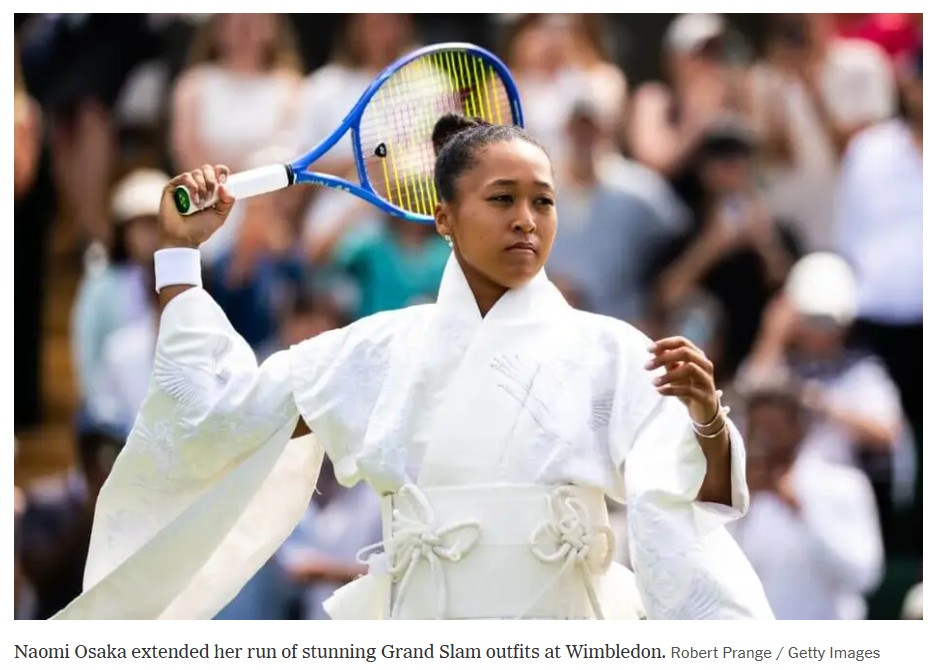
What I didn’t know then, and learned later reading through the New York Times’ coverage of the tournament, was that the outfit wasn’t a loophole in Wimbledon’s notoriously strict all-white dress code, it was a direct response to it. Osaka told reporters that when she thinks about the tournament’s obsession with tradition, she thinks about her own heritage, and that a kimono is one of those silhouettes you recognize by shape alone, no color required. She’d pulled the reference from Lucy Liu’s character in Kill Bill, of all places, and underneath the kimono was a Nike dress with its own embroidered flowers, so the whole entrance was really two outfits doing two different kinds of work. One paid tribute. The other one played tennis.
I’ve never been a person who watches sports for the outfits. I watch for the outfits now. There’s something about a 150-year-old dress code, the kind of rule that could easily read as restrictive, being treated instead as a canvas that got me thinking about tennis differently than I had before. I’d always filed it under a sport for other people, the ones with country club memberships and family coaches from age six. Osaka’s entrance didn’t make me want to be a Wimbledon champion, obviously, but it made me curious about the game itself in a way nothing else had.
So I did what any mildly obsessed adult does. I bought a racquet that was probably too advanced for me, found a pair of shoes with actual court grip instead of my usual running shoes, and started looking for somewhere to play. This is where the romance of the sport met the logistics of actually doing it. My city’s courts, it turns out, run almost entirely through tennis booking software now, an app where you reserve a slot, pay a small fee if it’s a private facility, and show up without having to loiter by a fence hoping the group ahead finishes soon. It’s not glamorous. It’s not a kimono. But it’s the difference between an idea staying an idea and an idea becoming a Tuesday evening habit.
I’m still bad at tennis. My serve has no business being called a serve. But I keep going back, partly for the game itself and partly, I’ll admit, because there’s something satisfying about showing up to a court with any intention at all, dress code or not. Osaka gets to turn a tournament rule into a cultural statement. I’m just trying to drop the ball in the box. Different stakes, same court.